![NWP [FAVICON] Dark Background.png](https://static.wixstatic.com/media/984aa3_88f6c98bf8be46f18027f16e3ec47c67~mv2.png/v1/fill/w_653,h_500,al_c,q_85,enc_avif,quality_auto/NWP%20%5BFAVICON%5D%20Dark%20Background.png)
The Room Was Always Part of the Mix

Updated: Jun 24
I regularly hear the same advice; advice that sounds convincing because, historically at least, it was correct. But even the best advice rarely survives contact with time.
The studio monitors Vs headphones argument falls into that category.
The recurring claim is if you want to mix properly, you need to monitor on speakers. Headphones are secondary - useful for checking details, perhaps, but not something to rely on seriously.
There’s still some truth in that thinking - in a well-designed control room, good monitors replicate sonic information in a way headphones just can’t. You’ll hear depth differently, stereo width behaves more realistically, low frequencies can be physically felt. A properly treated environment allows you to make decisions with the kind of confidence that headphones won't in the same way. The issue is, this advice was passed down as gospel while production environments shifted and evolved away from those original conditions.

The average modern producer isn’t working in a professionally designed control room. They’re working in bedrooms, student accommodation, garden sheds, and spare rooms doubling as offices, storage spaces, or somewhere to sleep. These are spaces with low ceilings, parallel walls, thin partitions, and neighbours on the other side of them. Spaces where monitoring loudly after midnight isn't a technical issue but a social one.
Yet the “just buy monitors” advice often comes stripped of that context. As though the speakers exist independently from the room they’re sitting in.
Not to state the obvious but rooms are not passive containers – the room becomes an active part of what you’re hearing. Standing waves exaggerate certain bass frequencies while cancelling others. Reflections from nearby surfaces - walls, ceilings, desks - interfere with the direct signal, and low-end information can shift dramatically depending on where you’re sitting. At that point, you’re no longer just hearing the speakers – you’re hearing the room’s interpretation of the speakers, and that changes the nature of the decisions being made.
A lot of beginner frustration in production gets framed as a skill issue long before anyone acknowledges the limitations of the space itself. Experience matters of course – critical listening is developed over years – and good engineers are good for a reason. But there’s still a real difference between lacking experience and trying to accurately judge unstable information.
Before you think I'm trying to make an argument for “headphones only”, I'm not. I'm just tired of watching the same conversations unfold with so few considering the bigger picture. Especially when the “just treat your space” retort comes up.

Yes, rooms genuinely do benefit from treatment - bass traps, reflection management, careful speaker placement, and improved room geometry all make an enormous difference in making speakers a more reliable monitoring method. But the issue is that people frequently discuss this like treatment is just small adjustments rather than major changes.
“Just treat your room” sounds simple until you realise full spectrum control can involve everything from resonant absorbers, cloud absorbers, and skyline diffusers, to huge, thick bass traps, multiple rounds of measurements, placement experimentation and enough control over the space itself to implement those changes properly. By the time many domestic spaces are treated adequately, the treatment can easily cost more than double the monitors they were looking at, and that's assuming the space is owned and not rented. If it's the latter, finding a landlord who'll support these types of alterations is like looking for a specific grain of sand in the Sahara.
Again, none of this makes the underlying principles less true. If anything, it reinforces them. The problem is that many conversations around production flatten themselves into consumer guidance, where buying the speakers becomes the important milestone and everything else quietly disappears into the background.
That gap between technical idealism and practical reality is probably why headphone-based workflows have become much more common than people might like to admit. Not because headphones are perfect, but because they remove one enormous variable from the equation entirely: the room.
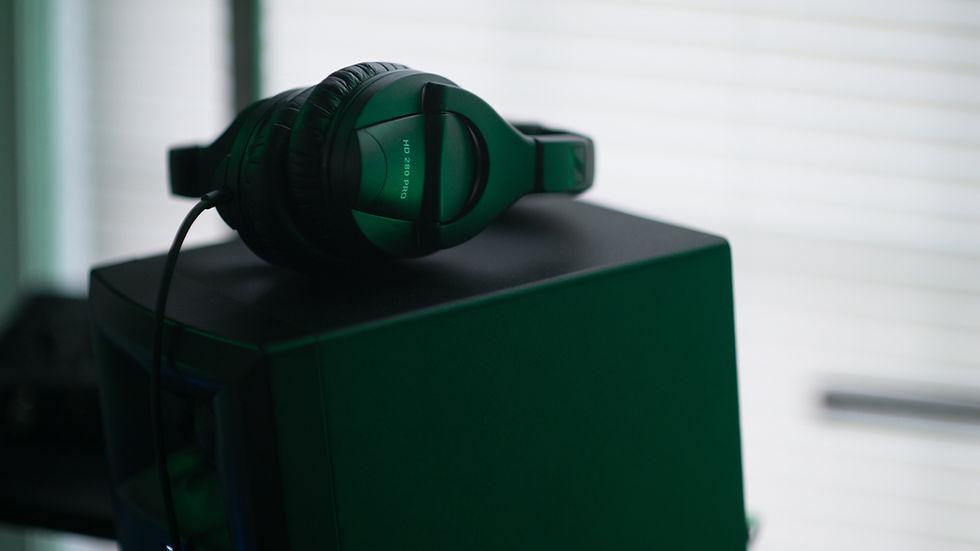
Established engineers like Andrew Scheps, Fab Dupont, and others have openly discussed headphone-heavy workflows in recent years, particularly when portability and consistency become more valuable than purism. But, even then, nobody sensible would present headphones as a flawless replacement for speakers.
Every monitoring setup has biases. The skill is not finding a system that never lies. It’s learning which lies are predictable enough to work around consistently, allowing reliable emotional and technical decisions to be made within the actual conditions somebody is working in, not the imaginary or idealised version of those conditions discussed online.
Studio monitors were never magically better in isolation. They were better inside environments built specifically to support them. Remove those conditions and the conversation becomes far more complicated, which is probably why so many producers quietly end up building hybrid workflows anyway.
The point is adaptation, not purity. And honestly? Adaptation has always been a more accurate description of music production than perfection ever was.
FURTHER READING
For readers who want to go deeper, the best starting point is REW, which lets you measure room modes, decay, and placement problems rather than guessing at them. For a practical next step, Dynaudio’s guide on monitor placement explains why symmetry, boundaries, and listening position matter so much in small rooms. If the room itself is the bottleneck, ADAM Audio’s article on home studio acoustic treatment is a useful introduction to what treatment can and cannot realistically fix.
For readers trying to understand why two people can hear the same mix differently, iZotope’s piece on psychoacoustics is a strong bridge between science and practice. And for the specific headphones-versus-speakers question, Sonarworks’ guide on mixing with headphones is especially relevant because it focuses on translation rather than ideology.


Comments